On-Site Services
Electrical Field Services
We bring 30+ years of switchgear expertise directly to your facility. Our technicians perform breaker rebuilds, primary injection testing, and transformer services on-site, minimizing your downtime and keeping your operations running. We service all major OEMs including GE, Westinghouse, ABB, Siemens, Square D, Cutler-Hammer, and ITE.
We Come to You
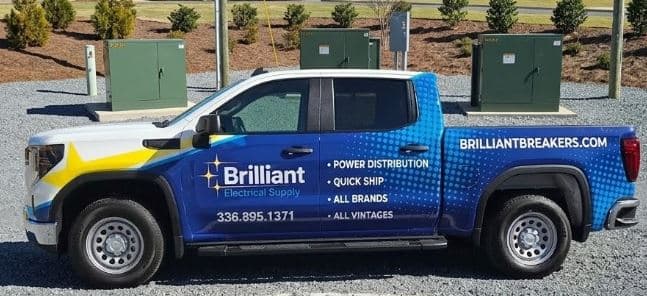
Our fully-equipped service trucks are ready to deploy to your facility anywhere in the region. Whether it's emergency troubleshooting or scheduled maintenance, we handle switchgear, breakers, and transformers on-site so you don't have to ship equipment or wait for shop repairs.
- 1-year warranty on all rebuilds
- Calibrated test equipment verified annually
- 30+ years combined field experience
- In-house plating for faster turnaround
Circuit Breaker Services
Industrial facilities often run breakers that have been in service for decades. OEMs discontinue parts, but the switchgear housing is still perfectly functional. Our breaker services restore equipment to like-new performance at a fraction of the cost and lead time of full replacement.
Low and Medium Voltage Breaker Rebuilds
Most RequestedA complete disassembly, inspection, and restoration of power circuit breakers. All contacts and live components are replated with silver, the frame is powder coated, springs and mechanical linkages are inspected or replaced, and the unit is reassembled and tested to manufacturer specs. A full rebuild restores the breaker to like-new performance, typically saving 50-70% versus full switchgear replacement while avoiding the 26-52 week lead times common on new medium voltage gear.
We handle all major legacy OEMs: GE AK/AKR, Westinghouse DB/DS/DH, ABB/ITE K-line, Siemens/Allis-Chalmers, Square D, Cutler-Hammer/Eaton.
Air to Vacuum Conversions
High ValueReplacing obsolete air-magnetic or air-blast interrupting mechanisms with modern vacuum interrupter technology. The new vacuum breaker is engineered as a direct drop-in replacement that slides into the existing switchgear cubicle without modifying bus work or the enclosure. This eliminates parts obsolescence issues (especially arc chutes), removes potential asbestos-containing components, and delivers faster clearing times, higher interrupting ratings, and significantly longer maintenance intervals. Vacuum interrupters are essentially maintenance-free for 10,000+ operations or 20+ years.
Retrofit platforms include GE Magne-Blast, Westinghouse DB/DH, ABB K-line, Siemens, and other legacy switchgear.
Trip Unit Retrofits
Replacing obsolete electromechanical or early-generation electronic trip units with modern microprocessor-based units. The new trip unit mounts into the existing breaker frame using a retrofit kit. Modern solid-state units offer fully adjustable long-time, short-time, instantaneous, and ground fault protection (LSIG) with precise time-current coordination. They also provide fault event logging, metering (amps, volts, kW, power factor), communication capability, and alarm outputs. This eliminates the drift and inconsistency of aging thermal-magnetic elements and allows proper coordination of upstream and downstream devices.
Kits available for virtually every major 480V/600V power breaker. Full primary injection verification after installation.
Contact Retipping
Every time a breaker operates under load or clears a fault, the arc erodes the silver contact surface. Over time this causes increased contact resistance, heat buildup, and eventually failure. Retipping involves removing, machining to restore flatness, and replating with silver or silver-tungsten alloys. Our in-house silver plating means faster turnaround and tighter quality control versus sending parts out.
Charging Motor Rewinding
The charging motor compresses the closing spring in stored-energy breakers. If it fails, the breaker cannot close remotely or automatically reclose after a trip. Signs include slow charge times, tripped motor overloads, or failed insulation resistance tests. OEM replacement motors for legacy breakers are often discontinued, making rewinding the only option. We match original voltage, speed, torque, and duty cycle specs exactly.
Testing and Diagnostics
Proper testing is the difference between planned maintenance and emergency repairs. Our technicians use calibrated, NIST-traceable equipment to verify your protection systems are operating correctly.
Primary Injection Testing
Gold StandardHigh-magnitude current (100A to 20,000A+ depending on breaker rating) is injected directly through the primary conductors to verify that the entire protection chain operates correctly: current sensors, wiring, trip unit, and mechanical trip mechanism. Trip times are recorded and compared against the manufacturer's published time-current curves. This is the gold standard for breaker verification because it tests the complete system end-to-end. Secondary injection testing (applying a signal directly to the trip unit) can miss problems with CTs, wiring, or contact resistance that primary injection catches.
Testing covers all four protection zones: long-time (overload), short-time (delayed fault), instantaneous (bolted fault), and ground fault. Formal test reports provided.
Switchgear Inspections
Comprehensive examination of medium and low voltage switchgear assemblies per NFPA 70B and NETA standards. Includes visual inspection, infrared thermography, contact resistance testing of bus connections and cable terminations, insulation resistance testing, mechanical operation checks, cleaning, lubrication, and torque verification of bolted connections. NFPA 70B became a mandatory standard (no longer just a recommended practice) in 2023, requiring documented electrical preventive maintenance programs. Neglected switchgear is the leading cause of arc flash incidents. Regular inspections catch loose connections, deteriorating insulation, and misadjusted protective devices before they cause unplanned outages.
Breaker Calibration
Verifying and adjusting trip settings so breakers operate at the correct current levels and within the correct time delays. Aging thermal elements drift, mechanical linkages wear, and electronic components degrade. Calibration ensures the breaker will perform as designed during an actual fault. Results include measured trip points at multiple current levels compared against published curves. Both an NFPA 70B recommendation and an OSHA requirement, typically performed every 3-5 years.
Troubleshooting
Systematic diagnosis of electrical failures in switchgear, breakers, motor control centers, and distribution equipment. When critical equipment fails, every hour of downtime costs money. Our deep familiarity with legacy equipment from all major OEMs, combined with access to legacy documentation and in-house repair capability, means we can identify the root cause and execute the fix on the same visit rather than waiting for parts procurement.
Transformer Services
Transformers are among the most expensive and longest-lead-time assets in any facility. A large power transformer failure can mean 12-18 months for replacement. Regular testing and maintenance catches developing problems before they lead to catastrophic failure.
Transformer Testing
A suite of electrical tests to assess transformer condition: turns ratio testing (verifying winding ratios), winding resistance measurement (detecting shorted turns or loose connections), insulation resistance / megger testing, power factor / dissipation factor testing (detecting moisture and contamination), and sweep frequency response analysis (SFRA) to detect winding deformation. Testing is especially critical after through-fault events (downstream short circuits) which mechanically stress windings. Tests follow IEEE C57.152 standards with results trended against previous inspections to identify degradation patterns.
Oil Sampling and Dissolved Gas Analysis
Critical PreventiveOften called the "blood test" for transformers, dissolved gas analysis (DGA) is the single most valuable predictive maintenance tool for oil-filled transformers. Oil samples are analyzed via gas chromatography to measure dissolved gases, each pointing to a specific fault type: hydrogen indicates partial discharge, ethylene indicates high-temperature thermal faults, and acetylene indicates active arcing. Additional tests include dielectric breakdown voltage, moisture content, acid number, and furan analysis (which specifically indicates paper insulation aging). A single oil sample costs a few hundred dollars; a transformer failure costs hundreds of thousands. DGA can detect developing faults months or years before they cause failure, allowing planned intervention.
Repair and Reconditioning
Ranges from minor repairs (replacing gaskets, bushings, gauges, and reprocessing oil) to full reconditioning (pulling the core and coil assembly, inspecting for insulation degradation, replacing insulation materials, re-clamping windings, and reprocessing oil). A full reconditioning costs 40-60% of a new transformer and can be completed in weeks rather than the 12-18 month lead time for new units. For legacy or custom-spec transformers (odd voltages, impedances, or tap configurations), reconditioning may be the only practical option.
Specialty Capabilities
These in-house capabilities set us apart from typical service companies and allow us to handle jobs that others can't, with faster turnaround and better quality control.
In-House Silver Plating
Rare CapabilitySilver is the most electrically conductive metal. Silver-plated contacts and bus connections provide stable, low-resistance joints that minimize heat generation and energy loss. Very few switchgear service companies have their own plating lines due to the capital investment and regulatory requirements. Having this in-house reduces turnaround on breaker rebuilds by 1-2 weeks versus sending parts out, and gives us direct quality control over plating thickness and adhesion.
Zinc Plating
Zinc provides sacrificial corrosion protection for steel and iron components: hardware, mounting plates, brackets, and structural members. During a full rebuild, all non-current-carrying steel components are re-plated to restore corrosion protection, especially important for equipment in humid or industrial environments. Combined with silver plating for electrical components, this means rebuilt equipment comes back with every part restored, not just the electrical ones.
Contactor Rebuilds
Complete disassembly and restoration of NEMA and IEC contactors used in motor control centers. Includes replating contacts with silver, replacing arc chutes and springs, nickel plating moving mechanical parts, and full operational testing. MCCs in industrial facilities often contain hundreds of contactor-based starters, and a failed contactor means a dead motor and a stopped process. Rebuilding is far more economical than replacing entire MCC buckets, especially for legacy equipment where new buckets may not be available. We handle all major MCC platforms: GE 7700, Westinghouse 2100, Square D Model 6, Siemens, and Cutler-Hammer Advantage/Freedom.
Hard-to-Find Parts
Many industrial facilities operate switchgear and breakers manufactured by companies that no longer exist (Allis-Chalmers, Federal Pacific, ITE, Gould, Brown Boveri) or models that have been out of production for 20-40+ years. When a critical part fails, we maintain extensive warehouse inventory of breakers and parts going back decades, along with the knowledge to cross-reference part numbers across manufacturer lineages (e.g., ITE to Gould to ABB to ABB/Siemens). Combined with our in-house machining and plating capability, we can solve problems that pure parts-sourcing companies cannot.
Ready to schedule on-site service?
Tell us about your equipment and we'll get a technician to your facility.